
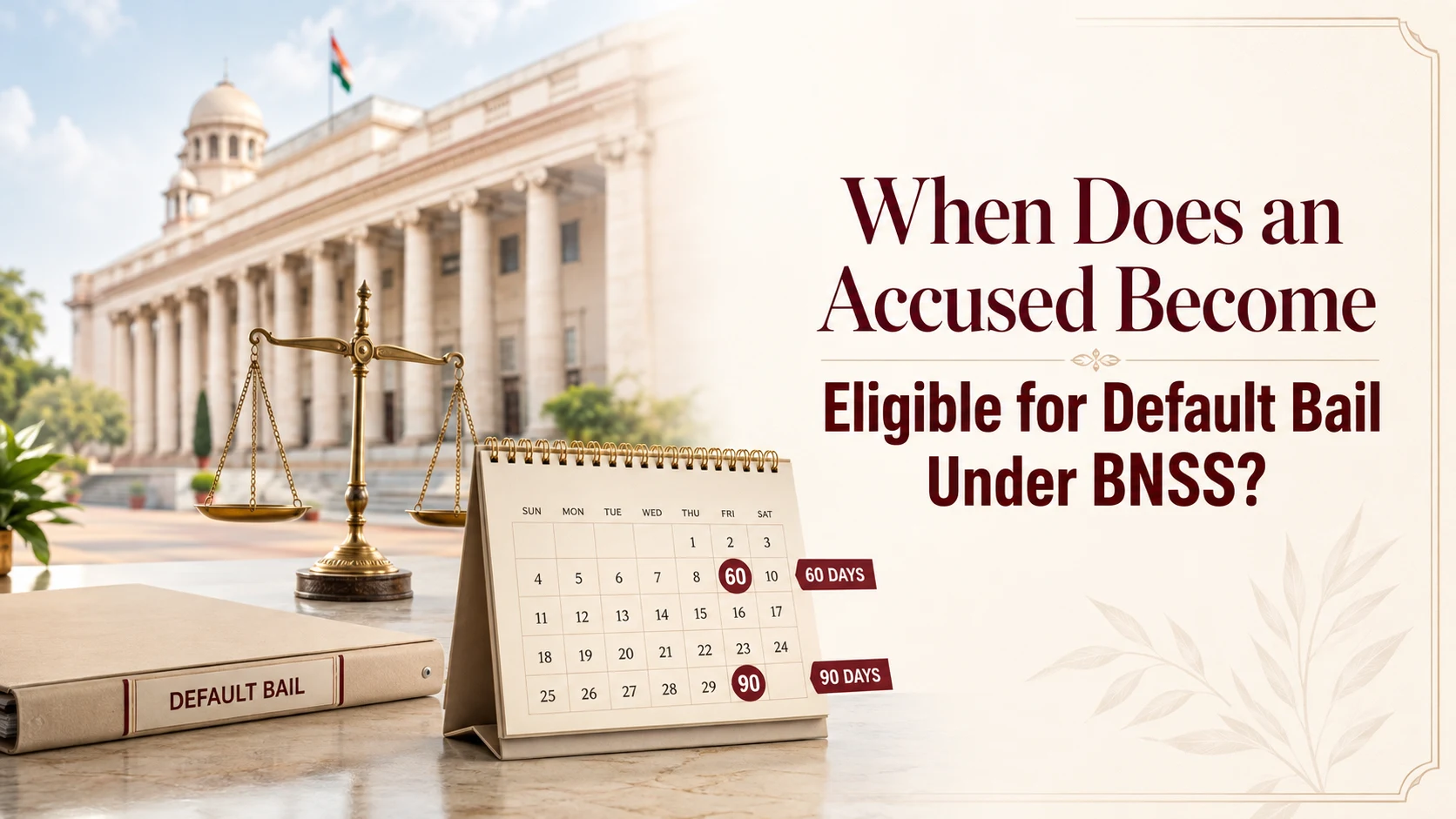
When Does an Accused Become Eligible for Default Bail Under BNSS?
An accused can be put in prison even if no court has declared that person guilty. Every remand date asks the same question for the family: how much more can investigations be prolonged without filing of a police report?
There is now a statutory limit on investigative custody under Bharatiya Nagarik Suraksha Sanhita, 20 23. Section 187(3) says an accused will become eligible for default bail after the relevant 60 or 90 day period has run, if the investigating agency does not file the report it is required to file, & the accused is ready to give bail.
Simple! Right? In reality arguments are made about the date from which custody must be counted from, the punishment prescribed for the alleged offence, if a proper charge- sheet was filed before expiry of the default bail period & if a special law provides a longer time frame to investigate.
Default bail is also misunderstood by families for regular bail. Bail pleas are generally decided on judicial scrutiny of allegations, proof, need for custody & risk of influencing witnesses. Default bail is a right that results from the prosecution’s failure to file a charge sheet within the statutory period.
Mistiming matters. An ex-parte order or delayed application, wrong tallying of custody or charge-sheet filed just before the time limit expires can substantially alter the claimed entitlement. BK Singh Advocate analyses these issues with reference to the FIR, remand transactions, penal provision invoked & court records.
You will understand the legal issues, debatable facts & implications of claiming default bail only. We do not advise on a filing strategy or guarantee release.
Why Does Default Bail Matter Across India in 2026?
Default bail ensures that continued investigative custody of an accused does not exceed an undefined statutory period. This matter concerns clients appearing in Magistrates & criminal courts in Delhi NCR, Mumbai, Nagpur, Bengaluru, Hyderabad, Lucknow, Jaipur & other cities of India.
Extended remand can interfere with the accused person’s job, education, medical care and family obligations. It can also limit the accused person’s ability to confer with counsel and gather evidence for the defense.
Although the law is consistent, court record keeping and administrative procedures may vary. Production/remand orders may not be readily accessible for the family. Arrest & production dates may vary. Multiple offences with different terms of punishment may be noted on the same FIR.
BK Singh Advocate has often observed families who know the date of arrest, but do not have an entire set of production/remand orders. This gap has lead to significant conflict about when the statutory limit ends.
Readers who are looking for basic education on matters pertaining to bail after custody can visit Best Bail Lawyer. Please note: This is a hyperlink that I will use only one time because of the internal-link rule.
Quick Facts About Default Bail Under BNSS
- Section 187(3) BNSS: The ordinary 60- and 90-day limits are dealt with.
- Offence punishable with death, imprisonment for life, or imprisonment for ten years or more – Relevant period is 90 days.
- Any other offence Relevant period is 60 days.
- Default bail accrues only when this period expires and police have not filed a report as required.
- The person accused of the offense must also be ready to give bail.
- Criminal laws that are specific may allow a longer time or even permit an extension as long as it is lawful.
- Default bail upon expiry of the statutory period does not result in automatic acquittal/termination of investigation.
The periods are mentioned in Section 187 BNSS itself.
What Is the Core Legal Problem in Default Bail?
Default bail or Statutory bail deals with the legality of further detention after the time allowed for investigation expires. It does not arise from any judicial finding that the accusation is groundless or that the accused is innocent.
The issue is whether the statutory right had accrued at the relevant time. Ordinarily four facts control the question- the lawful date of remand, period of custody allowed thereunder, the position in the police report and the accused' willingness to furnish bail.
Default bail is not regular bail
A routine bail plea essentially asks the court to review the severity of the accusation, the attributed role, antecedents, material evidence, likelihood of fleeing from justice and affecting witnesses.
Default bail is related to investigative lag time. However, release is not mechanically granted just because a time frame has elapsed. Explanation I to Section 187 makes it clear that he shall continue to be detained till bail is provided by him.
BK Singh Advocate views this differentiation as important because points relevant for regular bail can obfuscate the specific statutory issue of default.
Eligibility does not decide guilt
Release on default bail does not extinguish the FIR, nor does it halt further investigation or forestall trial. Further investigation can take place and the investigating agency can file a police report at a later date. Release on default bail also does not always rectify public opinion.
One problem is public perception. Families tend to see default bail as evidence that the case was bogus. Complainants see it as a dismissal they didn't deserve. Neither of these characterizations are correct from a legal standpoint.
Is the Default Bail Period 60 Days or 90 Days?
Which period applies? It depends primarily upon what the punishment prescribed by law for the offence under investigation actually is. It doesn’t depend on how serious the complainant chooses to word the FIR….
So, if we go by way of Section 187(3) who canNinety Days- If the offence is punishable with death, imprisonment for life, or imprisonment for ten years or more.
- – Sixty Days- If the investigation is for any offence other than those listed above.
Confusion can occur when one FIR alleges many sections. Some may be 60 days offence while another section would push the allegation into a 90 day offence. Adding to this confusion can be alterations to the provisions actually “invoked” during investigation.
Misreading the maximum punishment can lead to miscalculating the expiry date. That’s why BK Singh Advocate attaches great importance to knowing the exact penal provision & punishment clause when performing any default-bail analysis.
Visit the website’s page on default bail under Section 187 BNSS to understand the difference between statutory bail & bail on merits.
1/5
From Which Date Is the Custody Period Counted?
Custody calculations often become contentious where arrest, production and remand do not appear to occur on a simple sequence of dates. Police records, arrest memos and judicial orders may describe different events.
The remand date assumes particular importance. Counting errors of a single day can determine whether an application was premature, timely or made after the prosecution filed its report.
Further complications may arise where:
- The accused was arrested in another State and produced through transit proceedings.
- Different accused persons were arrested on different dates.
- The accused was initially detained in another connected case.
- Hospitalisation, police custody and judicial custody appear in the remand record.
- The remand order contains an unclear date or clerical inconsistency.
A family’s informal calculation cannot replace the judicial custody record. BK Singh Advocate reviews the remand sequence because an assumed date may not match the date legally recognised by the court.
What Happens When a Charge-Sheet Is Filed Near the Deadline?
The timing of the filing of the police report becomes critical. If an enforceable report is filed prior to the proper invocation of the statutory right, then the prosecution will contend that no valid default-bail claim arises thereafter.
Filing on the last-day leads to questions of fact. Was the report filed with the court which had competent jurisdiction? Was it sent officially? Was it connected to the investigation for which the accused was in custody? Was the filing substantive enough to qualify as filing of the mandated police report?
Default bail may also be claimed by an accused person after the expiry-date, but before the charge- sheet is actually filed. The actual timeline then becomes important. Records of filing in Court, date/time stamps, the language of any orders and applications etc. may become topics of argument.
If the defence characterizes a police report as incomplete, then an entirely separate controversy is created. Simply labeling a charge- sheet as “incomplete” does not automatically mean it is “legally invalid”. The Courts analyse what it says, and if it complies with statutorily mandated requirements.
BK Singh Advocate will not automatically assume that because there is an issue at the last minute or with an additional investigation report that default bail is automatically warranted. The nature and timing of the report is determined on a case by case basis.
Can Special Laws Change the Default Bail Timeline?
The timing of the filing of the police report becomes critical. If an enforceable report is filed prior to the proper invocation of the statutory right, then the prosecution will contend that no valid default-bail claim arises thereafter.
Filing on the last-day leads to questions of fact. Was the report filed with the court which had competent jurisdiction? Was it sent officially? Was it connected to the investigation for which the accused was in custody? Was the filing substantive enough to qualify as filing of the mandated police report?
Default bail may also be claimed by an accused person after the expiry-date, but before the charge- sheet is actually filed. The actual timeline then becomes important. Records of filing in Court, date/time stamps, the language of any orders and applications etc. may become topics of argument.
If the defence characterizes a police report as incomplete, then an entirely separate controversy is created. Simply labeling a charge- sheet as “incomplete” does not automatically mean it is “legally invalid”. The Courts analyse what it says, and if it complies with statutorily mandated requirements.
BK Singh Advocate will not automatically assume that because there is an issue at the last minute or with an additional investigation report that default bail is automatically warranted. The nature and timing of the report is determined on a case by case basis.
Why Can an Accrued Default-Bail Claim Still Become Disputed?
Eligibility and actual release are not identical. Section 187 requires the accused to be prepared to and actually furnish bail. Continued custody may occur where the bond, surety or other conditions remain unfulfilled.
Another serious problem is timing. If the accused does not assert the accrued right before a valid police report is filed, the legal position can change. Families sometimes wait because they assume the court will release the accused automatically once the 60th or 90th day passes.
That assumption is risky. Judicial release requires a court order and compliance with the imposed conditions.
Other disputes may concern the accused’s ability to provide an acceptable surety, verify an address or meet attendance conditions. BK Singh Advocate regards these practical barriers as distinct from the initial question of statutory eligibility.
What Problems May Continue After Default Bail Is Granted?
Default bail does not close the criminal case. Investigation, supplementary investigation, cognisance and trial may continue according to law.
The accused may remain subject to conditions relating to attendance, travel, contact details or cooperation with the proceedings. Breach of those conditions can expose the accused to cancellation proceedings.
Release may also create false confidence. The prosecution can still rely on documents, electronic records, witness statements, recoveries and forensic material later placed before the trial court.
A complainant may misunderstand release as a rejection of the allegations. Conversely, the accused may wrongly believe that no further court appearance is required. BK Singh Advocate stresses in published legal information that default bail concerns custody limits, not the final merits of the prosecution.
Which Documents Reveal the Default-Bail Problem?
Below is the list of papers that usually decide if a purported right has arisen:
- FIR and particulars of each offence alleged.
- Arrest memo that has date/time of arrest noted therein.
- First production/remand order.
- Further police-custody order(s)/judicial-custody order(s).
- Order sheets of the trial court.
- Date of filing of charge-sheet/police-report.
- Receipt of filing, court stamp or e-stamp.
- Application(s) for extension under the special law.
- Order granting/denying extension by the Court.
- Prior bail applications/orders.
- Detention warrant and jail memo.
- Bond/surety document proposed to be filed, if any already filed.
Incomplete or conflicting documents can muddy the math. BK Singh Advocate says he trusts the court’’s authenticated or court-stamped timeline over hearsay obtained from a PS or another accused’ family member.
When Does the Situation Require Immediate Legal Examination?
Immediate examination becomes relevant when the accused is approaching the 60-day or 90-day mark, the family cannot obtain remand orders, or the prosecution indicates that a charge-sheet is about to be filed.
Attention is also required where several penal sections carry different punishments, a special statute is involved, or an extension application appears on the court record. A disputed arrest or remand date increases the risk of an incorrect calculation.
Families may consult BK Singh Advocate when the issue concerns continued detention, a contested charge-sheet filing date or uncertainty between regular and default bail. Such consultation does not guarantee release; it identifies the legal and documentary problems requiring court consideration.
How Does BK Singh Advocate Examine a Default-Bail Matter?
BK Singh Advocate analyses arrest/challan date, sentence for each offense, remand memo,police-report approval and extension under special-law. Lets us know if the claimed right is legally maintainable or compromised due to filing/timing/documentation issue.
Visit the comprehensive bail & criminal defense services page to learn about the difference between anticipatory bail, regular bail, interim bail and default bail.
Advocacy is based on the circumstances, court record and relevant statute. BK Singh Advocate will not characterize default bail as automatic release or guarantee any specific court result.
Frequently Asked Questions
1. When does an accused become entitled to default bail under BNSS ?
After 60 or 90 days (as applicable) from the date of arrest, ordinarily. He must also be ready to offer bail. Statutory periods are subject to alteration under special laws.
2. Is default bail automatic after 60/90 days?
No. The period’s expiry creates a statutory entitlement, but release is subject to court’s order and provision of bail. Accused can legally continue to be in custody until he furnishes the required bond.
3. Which offences have 90 days time for investigation?
Offences punishable with death, life or imprisonment of 10 years or more get the 90 day treatment under section 187(3). All other offences get 60 days.
4. Is the arrest-date always considered day-1 for computation purposes?
The custody will start from the date mentioned in the relevant remand record of court. Issues arise when police arrest a person on date 1, produce him before court on date 2 and receive authorisation on date 3. Read the court’s record.
5. Can a person ask for default bail after charge-sheet is filed?
Yes, but the timing of accrual, invocation & filing matters. Accused who failed to invoke his right before filing of a valid charge-sheet would find it difficult to rely on default bail later.
6. If charge-sheet is incomplete, does that entitle a person to default bail?
No. Simply calling a report incomplete does not give rise to a default-bail claim. Court may look into whether the charge-sheet filed meets procedural necessities. Also, further investigation may just be pending.
7. Does default bail stop investigation ?
No. Even on default bail, investigation/criminal-p proceeding is not stopped. Police can file a subsequent report, undertake supplementary investigation, court can take cognisance and trial can commence.
8. Can a person’s default bail be cancelled ?
Typically not. Once released on default bail, the person is treated like any other person released under bail provisions of BNSS. Default bail may become cancellable if conditions are violated or other lawful reasons arise later.
9. Are NDPS and UAPA cases subject to these 60/90 day rules?
Special laws have their own prescribed periods & extension mechanism. We must look at the offence alleged, extension application and order of the court in such cases.
10. Will BK Singh Advocate assure default bail ?
No advocate can assure you bail. BK Singh Advocate can review the dates of custody, type of punishment for alleged offence, status of police-report and court record, but can’t predict court’s decision.
Final Thoughts
Accused is entitled to default bail as per Section 187(3) BNSS when he is ready to provide bail & requisite period for investigation expires without police report. But, Simple as the rule may seem are contentious issues of dates, sanction clauses, special statutes & eleventh-hour filings.
Default bail safeguards from prolonged detention in investigative custody; it does not determine fault. BK Singh Advocate analyses these issues afresh on material remand & filing order as a one-day discrepancy or missed extension order can adversely affect rights.
Author Bio
BK Singh Advocate deals with bail matters, criminal defence, FIR, arrest, remand and custody matters. Issues of Regular bail / Anticipatory bail / interim protection and Statutory default bail are scrutinised under the Bharatiya Nagarik Suraksha Sanhita, 2023. He has been helping clients throughout Delhi NCR and other Indian jurisdictions (depending on the concerned court and case facts). His practice entails analysis of the FIR, custody timeline, relevant punishment, stage of investigation & judiciary record. No legal results are guaranteed as bail is dependent on the applicable statute, documents & facts submitted to the court.