
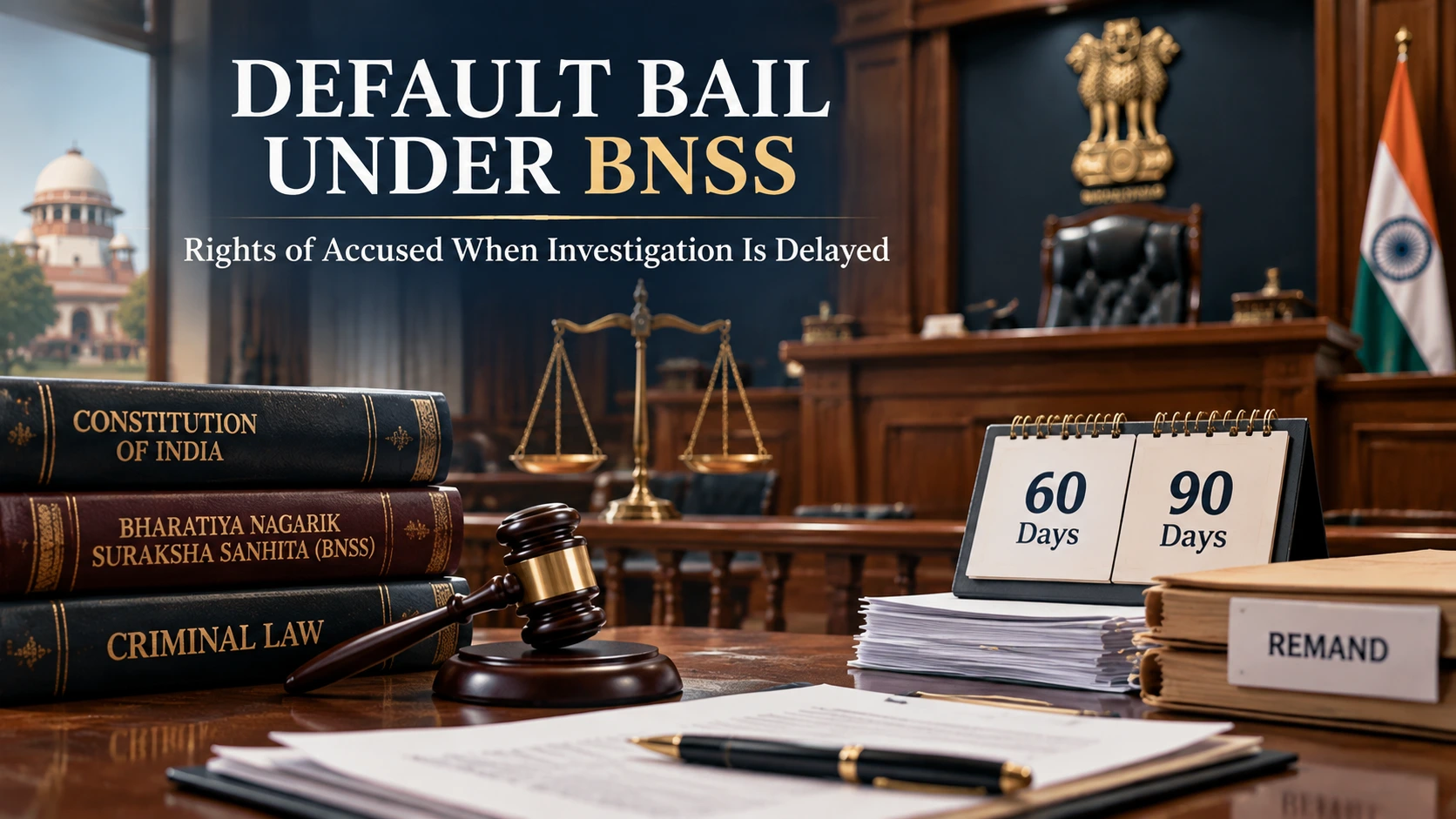
Default Bail Under BNSS: Rights of Accused When Investigation Is Delayed
It is scary to be arrested. For the suspect and family on the other side of the glass wall, it can be even more daunting to remain in custody while the investigation drags on.
The law on criminal procedure in India does not allow detention on the basis of investigation to go on forever, just because the police have not done their job. Statutory relief is available through default bail under BNSS when the investigating agency does not complete investigation and file report required to be filed within the period stipulated under law.
Know this deadline well if you live in Delhi NCR (Delhi, New Delhi, Ghaziabad, Noida, Greater Noida, Gurugram and Faridabad) and it can make the legal difference for your family. The concept is the same all over India but the court competent to entertain the application, filing procedure and actual practice in courts differs from case to case.
Section 187 of Bharatiya Nagarik Suraksha Sanhita, 20 23 (BNSS) is the law that governs granting of default bail. The law grants 60 days for default bail for general category of cases in Section 187(3). 90 days is granted for offences punishable with death, imprisonment for life or imprisonment for imprisonment for ten years or more. Read the statutory language which mandates release on bail if the period prescribed above expires and the accused offers to give bail.
What is important to note, but is missed often, is that default bail is NOT regular bail. Regular bail involves courts looking at the allegations, evidence if any, criminal history, risk of fleeing, concerns about the witnesses and need for further investigation, etc. Default bail is granted because the prosecution failed to complete the investigation in custodial period as mandated by statute.
Celebrated Advocate BK Singh suggests that do NOT try to figure out the deadline based on what you remember. Check from the court record – Arrest date, date of first remand sought/ granted, subsequent orders allowing custody, what offences were actually invoked, whether police have filed the report or not.
Why Default Bail is Granted in Delhi NCR and Across India in 2026?
If the investigation is delayed, it impacts more than the liberty of a person. The accused in custody could lose his job, business opportunities, get separated from his children/family members depending on who they are and find it difficult to collect documents/information for his defence.
Since Delhi NCR has its own practical difficulties as the accused resides in Ghaziabad/Noida and the FIR is filed at Delhi or he is arrested at one place and sent to the court at another place. One has to first ascertain the correct court and stage of proceeding to file the application in.
Different courts like Magistrate Courts/ Sessions Courts/ Special Courts/ High Courts could come into play depending upon the offence, custody scenario and kind of relief required. One cannot file a default-bail application based on a vague statement someone made that “his 90 days are over.”
One has to check the actual statutory calculations.
Let’s say the offence falls in the category of a 60-day investigation period. The defence has to figure out the cut-off date for calculating the period of custody as per law, compute the statutory period and then check if police filed a report within that period and if any extraordinary statute alters the normal rule.
BK Singh advocates prefer to verify the record first instead of listening to casual comments at police station/house.
Quick FACTs
Section 187(3) BNSS has laid down the general statutory provision for default bail.
60 days is the general timeframe, except for offences which fall in the category of 90-day timeline.
Offences which are punishable with death, life imprisonment or imprisonment of ten years or more fall under the category of 90 days.
Default bail is technical bail in comparison to bail which is granted on the merits of the accusation against the accused person.
Accused will have to claim his statutory right and also abide by the bail which may be demanded of him by the Court.
This time period for investigation can be different if there is a special statute dealing with the offence which prescribes a different time period for investigation or gives power to extend the same.
A police report contrary to the applicant’s claim and filed within the relevant time period can defeat the claim of default-bail.
What Is Default Bail Under BNSS?
Default bail is bail which arises by operation of statute. One situation where this arises is when an accused is in custody beyond the period allowed for filing of the report of completion of investigation and the report has not been filed by the prosecution within such period.
Section 187(3) BNSS states the basic rule. On expiry of the relevant 60 or 90-day period, the accused shall be released on bail if he is prepared to and furnishes bail.
This remedy is sometimes referred to as statutory bail. It is also referred to as compulsive bail. The terms default bail is used more commonly in judgments and practice.
Someone should not think that when an accused gets default bail, the criminal case against him is over. It is not. The FIR, investigation, prosecution and trial can all continue in accordance with law.
Default bail does not mean that the accused has been acquitted or found innocent either.
Which Law Applies To Default Bail In India?
Section 167(2) of CrPC applied earlier. BNSS came into effect on 1 July 20 and replaces CrPC.
Section 187 lays down how custody authorized by a Magistrate will work where investigation cannot be completed in the first 24 hours. Section 187(2) also modifies how police custody can be authorized during the initial period of the total period of detention.
It depends on the punishment provided for the offence. Merely based on the statement of allegation at the police station, we cannot say which period would apply.
Note that special laws can alter the position. For instance, NDPS Act and UAPA have special provision for investigation and extension. So a lawyer needs to find out if the person is charged under BNSS alone or in addition to a special statute.
Recent Supreme Court judgments also continue to uphold the significance of the statutory custody period and distinction between default bail and regular bail.
Who Can Benefit From This Legal Protection?
Default bail applies when an accused is in custody and investigation is close to statutory period.
Default bail can become an issue in cheating cases, criminal breach of trust, forgery, financial wrongdoing, cybercrime, assaults, conspiracy etc. where investigation may take many weeks or months.
Families should be especially watchful when police are seeking repeated remands or where the accused has been in custody for long periods.
Don't wait until the eleventh hour if you have a statutory deadline approaching. A day or two can make a difference in the eyes of the law.
Advocate BK Singh can review your FIR, custody orders and status of police-report to assess if a statutory-bail issue needs to be addressed.
Documents For the Family to Gather?
Typically, bail by way of defaults is strongest when one can show the custody timeline via authentic records.
Examples include:
- FIR and subsequent complaints/orders that add/alter offences
- Memo of arrest
- First production/remand order
- Subsequent orders for police/judicial custody
- Jail/custody doc: note this may not be available
- Copies of any applications made to court for additional custody
- Information of when the police report/charge-sheet was filed
- Acknowledgement of filing from the court/filing through e-court, if available
- Any application made under a special law for statutory extension(can be very important)
- Copy of any previous bail orders
- Documents for identities/address of applicant/sureties
- Documents of proposed surety
In any case, families should keep scanned copies of any/orders that are important. Online case-status reports won’t necessarily have the entire filing history/timelines for a contested issue.
When to Approach a Lawyer?
Counsel needs to be approached when the arrested person has been in custody for few weeks; when police are seeking remand; when charge-sheet seems imminent; when various offences have been inserted during the course of investigation.
Counsel needs to be approached if a special law is applicable to the case; the dates of custody are in dispute; if the case has been pending in multiple courts; or the family is unsure if the final police report has even been filed.
The aim is not to concoct a technicality. The aim is to figure out the correct legal position based on facts on record.
Advocate BK Singh can analyse the custody chart,following provisions, status of charge-sheet and any previous orders to guide you if default bail,regular bail or some other remedy is legally possible.
How BestBailLawyer Can Help?
As far as bail or arrest and FIR/criminal-defence related issues are concerned BestBailLawyer will provide legal representation in appropriate courts/jurisdiction.
If you have a default-bail issue, Advocate BK Singh will analyze FIR, first remand order, subsequent orders for custody, relevant punishment provisions and the status of police-report. We don't guarantee bail but ensure that the right remedy is suggested.
Often our clients stay in Delhi NCR but require help because the person accused lives at Ghaziabad,Noida, Greater Noida, Gurugram or Faridabad and the criminal case/proceeding is pending at some other place/jurisdiction. The appropriate forum would vary based on the facts.
FAQs
Q1. What is default bail under BNSS?
Ans. Default bail is bail that becomes available by statute when the investigating agency fails to complete investigation and file the requisite report by the relevant statutory period. Under section 187(3) BNSS, the applicable period will generally be 60 or 90 days, depending upon the maximum punishment prescribed for the offence.
Q2. If it’s statutory, do I get it automatically after 60/90 days?
Ans. No, not in the sense that you get released from custody without making an application. You must claim your statutory right and be ready to provide bail to the satisfaction of the court.
Q3. Is default bail same as a regular bail?
Ans. No. Default bail is granted by statute without regard to the merits/circumstances of the case. Regular bail is analysed based on the facts and merits of the case. Default bail is granted when the statutory period for filing the investigation report expires.
Q4. What is the 90 day rule?
Ans. Section 187(3) provides a mandatory 90 day period in which to file the police report if the offence is punishable by death, life imprisonment or imprisonment of 10 years or more. All other offences are subject to a 60 day default-bail period.
Q5. When do I start calculating the default-bail period?
Ans. Your custody/remand record will determine the legal starting date for computing the statutory period. The date of first remand has been treated as important by several Supreme Court decisions interpreting the old provision. Counsel should carefully check the actual dates rather than automatically using the date of arrest.
Q6. Can police file a charge-sheet after the 60 or 90 days are up?
Ans. This will depend on whether your right to default bail had already accrued under the statute and was properly claimed. The Supreme Court has recognised that fines distinctions can arise based on the timeline of when the statutory period expires, the bail application is made and the police report is filed.
Q7. If I get default bail, does it mean I’m innocent?
Ans. No, it does not. Getting released on default bail does not mean that your guilt has been decided. Your criminal case will continue after default bail is granted, subject to the applicable procedure and bail conditions.
Q8. Can default bail be claimed under NDPS or UAPA?
Ans. Yes, but those statutes have different investigation periods and procedures to extend the investigation period. NDPS and UAPA cases should be analysed separately rather than relying on a simple default bail 60/90 day calculator.
Q9. Can I file a regular bail application instead?
Ans. Default bail and regular bail are two different forms of relief. If a statutory right to default bail may have accrued, then you should carefully analyse that right instead of thinking that a regular bail application will achieve the same result.
Q10. Can police later cancel my default bail?
Ans. Just because you were released on default bail, it doesn’t mean that you are immune from all future court action. Default bail can later be cancelled due to breach of conditions, abuse of liberty, or other recognized legal reasons for cancellation of bail.
Conclusion
Section 187 BNSS grants default bail, which prevents the government from unnecessarily prolonging custody based on an investigation. However, that protection only applies if the appropriate offence category, period of custody, complaint filing, and applicable law are accurately determined.Family members should not wait until the police notify them that the deadline is approaching. And they should not expect an accused to be released simply because an investigation takes longer than expected.Defaults are triggered by Section 187 BNSS. But the actual claim will depend on the specifics of the record. Special statutes, police-report filing, grant of remand, and the timing of the application itself could alter the outcome. Advocate BK Singh suggests reviewing the case as soon as the accused nears the statutory limit for custody.
Author Bio
Advocate BK Singh handles bail, default bail, arrest, FIR and criminal-defence related cases in Delhi NCR and elsewhere in India. He analyses custody sheets, provisions of FIR, orders of remand, statutory deadlines, status of police-report and previous orders of court before recommending a legal course of action. Advocate BK Singh believes in communication, file analysis and trustworthy advocacy over promised outcomes. When representing clients for default bail, he emphasises Section 187 BNSS, relevant special laws, calculation of custody and process to follow for enforcement of a statutory benefit.